
Bamboo education
Can bamboo be safe? Yes, here's what that actually takes
We remove bamboo for a living, so this may surprise you: bamboo is not the villain. The American Bamboo Society, the authority on the plant, and an organization we're proud members of, puts it plainly in its Invasiveness & Control Statement: if planted and cared for properly, bamboo is not invasive.No bamboo is federally listed as a noxious weed. Bamboo prevents erosion, feeds and shelters wildlife, absorbs carbon, and makes a dense evergreen screen deer won't eat.
In almost every problem case the ABS reviewed, and in every one we've dug out in 50+ years, the story is the same: the plant wasn't planted properly, maintained properly, or disposed of properly. Bamboo doesn't misbehave. Plantings do.
Rule one: pick the right kind
Clumping bambooexpands a few inches a year and stays essentially where you put it. For most yards it's the safe choice, no engineering required. Running bamboo can be planted responsibly too, but only with real containment and a maintenance habit. If you won't commit to both, don't plant a runner.
Rule two: contain it like you mean it
How a rhizome barrier actually contains bamboo
A proper barrier is high-density polyethylene (HDPE), 60–80 mil thick, trenched 30–36 inches down with a two-to-three-inch lip above the soil. The lip matters: rhizomes that hit the barrier ride upward and show themselves at the surface, where they can be cut. The ABS is equally clear about what fails: buried pots, bathtubs, sheet metal (rusts), wood (rots), and thin plastic (rhizomes punch through). A barrier that stops short of 30 inches is a delay, not a boundary.
Rule three: prune the rhizomes on a schedule
No barrier is install-and-forget. The ABS calls rhizome pruning essential: once a year minimum, ideally three passes through the growing season, cutting back any rhizome that approaches the barrier's edge before it can jump the lip. A one-foot sand strip along the inner face makes those passes fast, which is exactly how we build our containment installations, and why we offer seasonal maintenance visits to do the pruning for you.
Where the line is
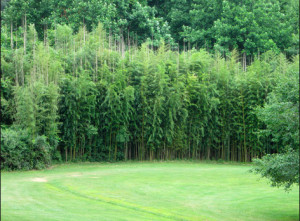
A planting has crossed from asset to problem when the rhizomes have: reached a property line, surfaced in lawn or beds yards from the grove, gotten under hardscape, or gone unmaintained long enough that no one knows where the roots end. At that point containment is no longer enough. The spread has to come out. The ABS's own guidance for unwanted bamboo matches how we've always worked: dig it out completely, don't poison the soil, and hire expertise for the job. That's full removal.
One more warning from the Society worth repeating: the plant sold as "Japanese bamboo" is actually Japanese knotweed, not a bamboo at all, far more aggressive, and responsible for a lot of bamboo's bad reputation. If your "bamboo" has broad leaves and hollow, jointed red-flecked stems, call us either way; we remove invasive vegetation of both kinds.
Want bamboo without the risk?
We install ABS-grade containment for bamboo you want to keep, and remove the spread you don't. Free consultation, written quote, one-year guarantee.